






Introduction

About the Organizer

The Cambridge University Finance and Investment Society (CUFIS) is one of the largest and most influential finance societies at the University of Cambridge. Meanwhile, the Cambridge Student Investment Fund (CamSIF) is Cambridge University’s most active, entirely student-led finance society. And CUFIS x CamSIF merged to form Cambridge's most influential finance society. CUFIS x CamSIF collaborates with various financial institutions and enterprises, and holds a wide range of events and challenges, aiming to bridge academia and industry, expand elite network in the financial sector and cultivate forward-looking economists and financial elites for the future. (Official Website: https://www.cufis.org/ )
CUFIS x CamSIF hosts a series of events throughout the year, including keynote speeches by senior executives from leading global enterprises, large-scale career development guidance events, seminars with financial experts, and financial challenges. These initiatives aim to provide Cambridge students with broader opportunities for academic learning in economics and finance as well as career advancement. With profound academic foundations and extensive industry connections, CUFIS x CamSIF has gained official recognition and support from world-renowned financial institutions, such as Goldman Sachs, Deutsche Bank, Jane Street, Scotiabank and Evercore. In the meantime, top-tier financial firms and investment banks including J.P.Morgan, Bank of America, Morgan Stanley, and Bloomberg have established in-depth event partnerships with CUFIS x CamSIF.
Leveraging the academic heritage of the University of Cambridge and the resource network with the world's top enterprises, CUFIS x CamSIF has become a core channel for cultivating and supplying elite talents to leading global financial institutions including Goldman Sachs, J.P.Morgan, Blackstone Group, and UBS, continuously shaping the leading forces in the future financial landscape.

CEFC Program Overview

The Cambridge Economics and Finance Competition (CEFC) is open to high school students worldwide who are eager to enhance their economic and financial literacy. It is committed to identifying future financial elites and providing outstanding students globally with an opportunity to integrate into the Cambridge financial elite network of CUFIS x CamSIF. This unique experience offers students a chance to gain in-depth insights into economics and finance as academic disciplines while engaging in practical financial operations.

The undergraduate programme in Economics at the University of Cambridge produces graduates who excel in the financial industry. This situation fully reflects the close integration of Economics and Finance. Economics emphasises theoretical frameworks, while finance is more concerned with practical applications, and the two complement each other in analysing financial phenomena with economic theories.
The explosive growth of emerging fields such as fintech, digital currencies and quantitative investment is a typical example of the integration of economic principles and practical financial operations. These fields demand talents who are proficient in practical financial skills while capable of providing in-depth economic and industrial insights.
Economics and finance are also highly interconnected fields at the university level. For many prestigious universities, finance courses constitute a core part of the economics curriculum. For instance, the Economics undergraduate programme at the University of Cambridge covers key content across multiple financial areas, ranging from financial markets to banking and finance. These courses help students understand the operating mechanisms of financial markets and their impact on economic decision-making.
The CEFC encourages students to apply their economic knowledge to explore the operational logic of the financial world. Building a comprehensive interdisciplinary knowledge structure of "Economics × Finance" in advance not only helps students gain an edge in university applications and academic studies, but also unlocks boundless possibilities for their future career development. It equips them to become true problem-solvers amid the increasingly complex economic landscape.

CUFIS X CamSIF Past Sponsors

Apollo Global Management

Evercore

Credit Suisse (UBS)

Goldman Sachs

Point72 Asset Management

Rothschild & Co

HSBC

Bank of America

Morgan Stanley

D. E. Shaw & Co

Glencore

Luno

PJT Partners

Dare International

Qatalyst Partners


Global Influence of CEFC

The 2025 CEFC preliminary round attracted the active participation of economics students from nearly 20 countries.

  • China

  • United Kingdom
    (UK)

  • United States of
    America (USA)

  • Germany

  • Belgium

  • India

  • Republic of Korea
    (South Korea)

  • United Arab Emirates
    (UAE)

  • Thailand

  • Singapore

  • Malaysia

  • Vietnam

  • Bangladesh

  • Qatar

  • Kazakhstan

  • Slovakia

  • Ghana

  • Mongolia

*Countries are listed in no particular order.

Cambridge Economics and Finance Competition

Prestige
CEFC is hosted by the largest finance society at the University of Cambridge which provide exclusive events, networking opportunities, and interactive workshops with the leading firms in the financial sector. The association maintains long-term close cooperation with top financial institutio ns and brings together industry experts to provide participants with the most forward-looking financial practices and resource support.
Economics × Finance
The deep integration of economics and finance, using data modeling, game theory, and behavioral economics methods, enables participants to master logic-driven decision-making thinking. This develops the ability to deal with the complexity of the financial environment and gain foresight and insights.
Financial highland
The winners of the qualifier round will have the opportunity to advance directly to the Cambridge Global Round, an immersive ‘study in Cambridge’. This is not only a high-level academic competition, but also a rare proof of academic ability in economics and finance.
Top-Tier External Events
CUFIS have prepared these events in the past, from speakers and panels, to socials and competitions. Last year, we welcomed such figures as the Global Head of Research at Citi, Global Head of Financing Quants at UBS, and the Co-Head of Goldman Sachs EMEA ECM.You will have more oppotunity to learn the cutting - edge trends in the financial industry.
Practical
Through immersive practical training such as in-depth stock research, market trend analysis, and investment and financing strategy development, participants will refine their data analysis and decision-making abilities under real market conditions, understand the operational mechanisms of the capital market, master core strategies to cope with market fluctuations and lay a solid foundation for future careers in finance.

Development Path

The Cambridge Economics and Finance Competition (CEFC) is divided into two rounds: the Qualifier Round and the Global Final. Top-performing participants in the Qualifier Round will have the opportunity to be invited to the Global Final, which will be held at the University of Cambridge in October 2026!

Qualifier Round

Competition Time:2026.4.18 (GMT+8)
Registration Deadline:2026.4.1
Format:50 MCQs, 90 minutes
Scope:Fundamentals of Economics and Finance
Eligibility:Grade 9-12
Format:Individual
Language:English
Academic suppor:The organizing committee provides an academic guide
Fee:Including registration fee, electronic certificate, administration and learning materials.

Awards

Honor Award:Top 5%
Gold Award:Top 15%
Silver Award:Top 30%
Bronze Award:Top 45%
Achievement Award:Top 60%
* Awards are conferred based on global rankings
Advancement:Students who win the Bronze award or above in the qualifier round will be invited to participate in the global final
Certificate:All students will receive a certificate of participation, and winner students will receive a certificate of award, which will be issued through an e-certificate.

Global Round

Students who win the Bronze award or above in the qualifier round will be invited to participate in the global final. Here, top students from around the world will transform from emerging economic talents into future leaders amid the academic halls and practical financial arenas of the University of Cambridge!
The Individual Economics Challenge in the Global Final will further enhance participants’ capabilities in applying theories and conducting data analysis. In the Stock Pitch, students will refine decision-making skills, enhance their academic presentation skills and teamwork competence.
During the featured academic sessions, Cambridge Economics scholars will share cutting-edge methodologies. Participants will have the opportunity to access Cambridge’s academic resources and master quantitative analysis tools. Lectures on economics programme applications will help students decode the admission logic of Oxford and Cambridge. Additionally, through sharing sessions by elite financial practitioners, students can gain insights into career paths in fields such as investment banking and asset management. Participants will achieve comprehensive improvements in theoretical knowledge, practical skills, and global perspectives!

  • Date: October 2026
  • Venue: University of Cambridge
  • Only 60 seats available

Competition Sessions

Economic Written Test

Multiple-choice questions and short-answer questions, a 90-minute English written test. The content modules are the same as those of the qualifier round, including macroeconomics, microeconomics, financial market, accounting, and valuation models.

Stock Pitch

No prior investment experience is required. CUFIS and CamSIF will provide all participants with a hands-on financial and stock market analysis, equipping them with essential tools and methodologies. Following the workshop, the Stock Pitch Competition brief will be announced. Students will then work in teams to apply what they've learned in a real-world case analysis, culminating in a group presentation and final report.

Academic Sessions


Keynote Speech

A Cambridge economics professor will deliver the opening address, offering cutting-edge academic insights.


Alumni Sharing

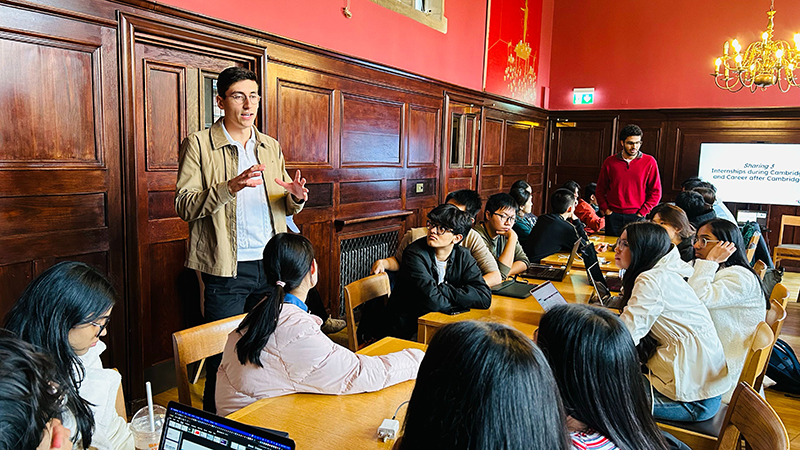
Cambridge alumni and CUFIS X CamSIF members will share their personal journeys, highlighting the real-world impact of studying economics and finance. Join roundtable discussions for career inspiration and opportunities.



Cambridge Application

Members of CUFIS and CamSIF will share their experiences applying to study Economics at Cambridge, including mock interview sessions designed to help students prepare for the highly competitive admissions process.



Networking Session

Engage with top young economists standing out from CEFC. Build lasting connections, exchange ideas, and expand your global perspective.



Formal Dinner

Take part in a traditional Cambridge formal dinner—an iconic part of college life. Dressed in formal attire, students will enjoy fine dining, and thoughtful conversation in a historic setting.

Academic


Modules

1. Microeconomics

Consumer theory, producer theory, market structure, general equilibrium and welfare economics

2. Macroeconomics

Core Economic Concepts, Economic Sectors and Their Roles, Government and Economic Management, International Trade and Exchange Rates, Aggregate Demand, Supply, Economic Cycles


3.Financial Markets

Financial Instruments & Market Participants, Key Market Concepts, Time Value of Money (TVM), Risk & Return, Bonds & Interest Rates

4. Accounting

Accounting Principles, Financial Statements (Income Statement, Balance Sheet, Cash Flow Statement), Asset, Liability & Equity Management, Business Performance & Ratios, Inventory & Cost Management

5.Valuation

Intrinsic valuation, Relative valuation

1.Which of the following is a characteristics of monopolistic competition

  • Price > Marginal Cost.
  • Efficiency.
  • Demand = Marginal Revenue.
  • Homogeneous or similar products.

2.If nominal GDP equals $30,000 and the GDP deflator equals 150, then real GDP equals

  • $200.
  • $20,000.
  • $30,000.
  • $32,000.

3.The primary goal of a financial market is to ___ risk, and __liquidity.

  • increase, increase.
  • increase, decrease.
  • decrease, increase.
  • decrease, decrease.

4.Buying computer to use in the business is an example of

  • a financing activity.
  • an operating activity.
  • an investing activity.
  • a delivering activity.
5.If the intrinsic value of a stock is greater than its market value, which of the following is a reasonable conclusion?
  • The stock has low risks.
  • The stock will offer higher dividend.
  • The market is overestimating the stock.
  • The market is underestimating the stock.
Score Inquiry考试入口/Exam Entry